
Thoughts on a classic and often overlooked Canadian Poetry collection.
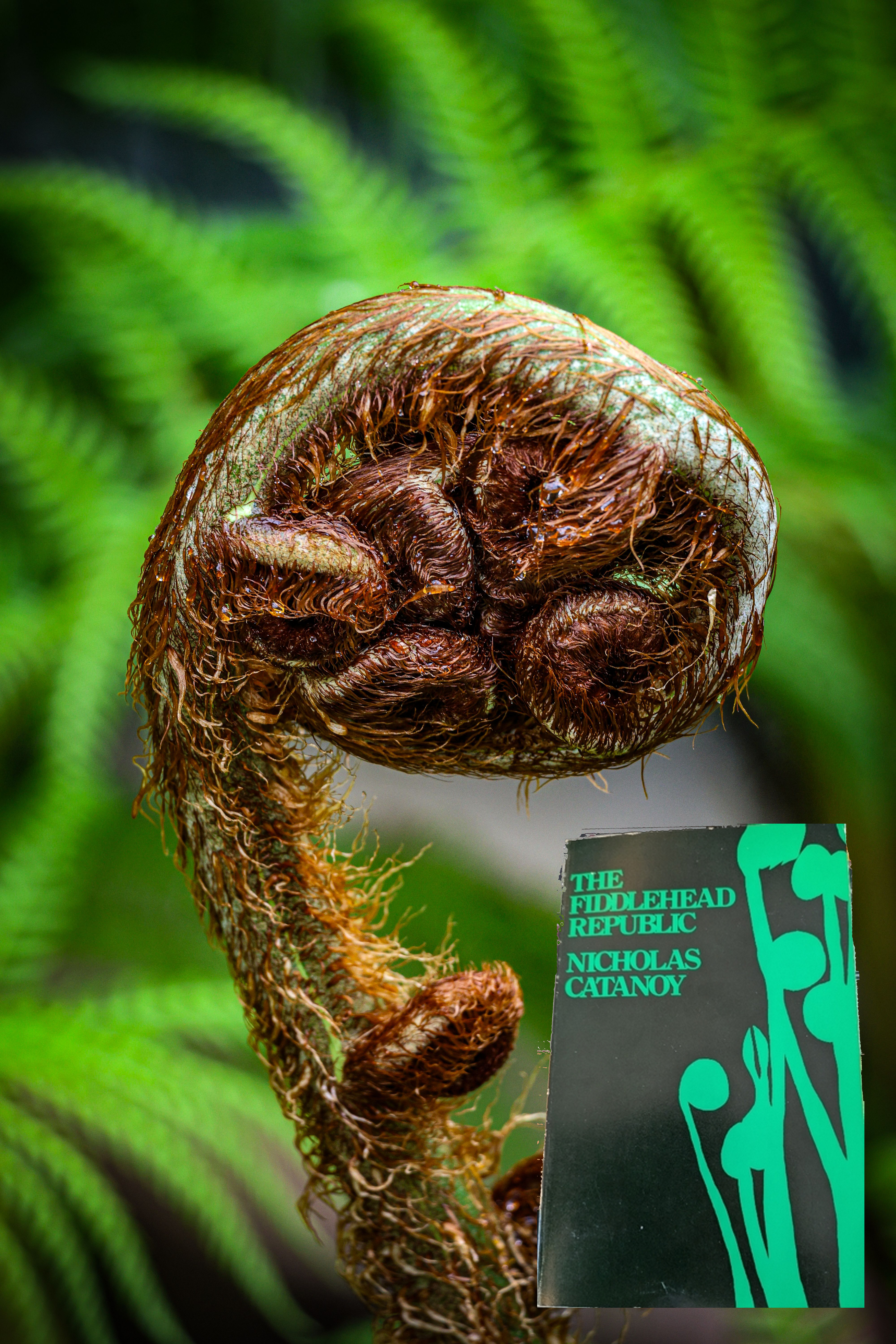
Recently, I wandered across a classic, if perhaps rare, Canadian poetry collection at my local bookshop. Published in 1979 through one of Canada’s now lost presses, Hounslow Press (acquired by Dundurn Press in 1990s), this relatively slim collection caught my eye during the course of my browsing. The premise of the collection was strongly tied to the physical land of Atlantic Canada. And as one knows, I am all in for eco-poetics. And why not one about one of Canada’s most overlooked ecosystems and physical spaces?
I must admit that I was not familiar with Catanoy or his work before buying this collection. A problem of my own ignorance rather than his celebrated life and work. A little bit of quick research done on my part to save you some time: Nicholas Catanoy (1925-2022) was a renowned writer born in Romania. He immigrated to Canada in 1962 and became a citizen in 1968. He worked as radiologist in Frederickton during his time in Atlantic Canada. Catanoy wrote in English, Spanish, French, and Romanian. He was widely published and appreciated his lifetime and most definitely prior to his retirement. He lived what many would call an interesting life travelling with the world, crossing cultural and physical borders, working for years as a fly-in doctor in the global south. He was retired by the time I graduated highschool. Catanoy is, unsurprisingly, an important part of my understanding of the Canadian poetry tradition
The Fiddlehead Nation, like the physical space it purports to examine, is a pastiche of the varied landscapes and peoples that the book’s voyages touch upon. From the shores of the Bay of Fundy and streets of Saint John to the forests and caves of Shediac to the city lights of Frederickton and ever-present survival of First Nations, this is work that captures a wonder snapshot of New Brunswick of the time. And is a snapshot without the heavy-hand of didacticism nor long-winded poetics. Voice and sound of the land and people take the center here. It differs much from a more familiar and recent book such as Shane Neilson’s New Brunswick. Neilson’s book is wonderful, but nowhere near as quiet and expansive in nature as Catanoy’s. Although, they are most definitely relatives separated by age and style, both share a common point of departure, the land itself.
Catanoy’s work with it’s keen sense of observation and tight almost haiku or senryu style poetics intertwined within found poetics and concrete observations crafts a strong flow for the reader. I would classify the work as an ancestor to Laurie Graham’s Fast Commute and most definitely in heavy conversation with Allen Ginsberg’s The Fall of America: Poems of These States. This is a book of the road, poetics in motion, witnessing the objective nature of the country it touches. Avant-garde is word thrown around in regards to this collection. And the term feels apt. Portions of brochures, historical journals, newspapers, and even roadside signs appear alongside and in direct connection to poetic meditations of the speaker on the physical world and people they encounter. And these connections provide fruitful explorations
As this book is a road trip style stream of consciousness approach to subject, the observable facts of the poetic speaker drive the work. I know and expect him to do well with the standard fare Euro-Canadian stuff. Which he does and does well. However, there are multiple points in The Fiddlehead Nation where Catanoy lingers in a meaningful way on Indigenous peoples of this space. And sure, he uses the problematic term “Indian” in our historical context, but this is due to accepted norms of the time rather than any intent to be derogatroy.
"RED BANK, Indian Reserve

Midwinter
Plows clear the road

An Indian tunes his drum between the majestic sequences of the fire

Greetings & Laughter

It is easier to interpret Bach than to interpret an Indian song
The snow thickens
Wind is untutored
No imperatives distract him from self-reliance & stoicism
Who told you all this? ” (Catanoy 1979, 19).

And the images here float in as a tourist witness moving upon the land. What strikes me here is the observation of the “untutored wind,” wild and untamed nature. And then there is very human form of the Native drummer and the fire. We witness the determinism and strength of the drummer. Which, while often stereotypical depictions of Indigenous people, this falls into a plausible and positive depiction of real Mi’kmaq caring on their culture. Self-reliance and stoicism are hardly negative in this case. In comparing Mi’kmaq drum songs to Bach, there is no statement as to which one is inherently better. Both are clearly open and of value to interpret. But unlike Bach, the drum of the Mi’kmaq man poses significantly more difficulty. And that difficulty, one can see is the point of mentioning that comparison and this man at all. So much of early and mid-twentieth century writing in Canada disappeared the “Indian.” But here, Catanoy depicts a strong living Indigenous nation.
In another section, the speaker finds themselves on the northwest portions of the Miramachi River. And there the speaker witnesses Indigenous children hunting with a slingshot. In this moment, Catanoy unpacks the history of the beaver trade and includes an Indigenous perspective of beaver as medicine. All in simply distilled down language. Indigenous people of Catanoy’s Fiddlehead Nation are living, breathing, nuanced people. Their history and reasoning are as important, if not more important, than many of the other residents appearing in the collection. Self-reliance is not simply a term Catanoy applies in the quoted section above, but simply through his depictions and actions of Indigenous people.
As said before, much of the Catanoy’s work here floats through the witness poetics of the speaker. While these moments are often tightly focused lens onto the portions of creation that he experiences, there are moments that rise to the grandeur of Atlantic Canada’s wild and wide-open spaces. And there are moments that capture the simplicity and the quiet of the land and place itself. This is a book primarily about the land itself and how the physicality of it, from trains to caves to forests and to sea, affects the outcomes for these people and becomes the governing awe and union of those that inhabit these spaces. And what comes of those moments are astoundingly beautiful passages like the one that follows. One that places the reader in the awe and splendor of the poet’s subject. That sense is tied to the land, the actual focus of his work. A work that often takes grand vistas of the land. A work that just as often takes the small and makes it larger than the sky itself.
“Across the river a melancholy wail warning
that the down train out of Newcastle was
on time.
Orion at dusk
There are no final words at four o’clock in the morning.”
(Catanoy 1979, 45).

As much as one thinks of the train whistle, the quiet around it is what we are drawn to. Consider the role of silence here. The space to breathe as reader. The space to feel the wonder and slow down to listen and witness as one moves through the world. And this sense of silence is not just in this passage but in the work as a whole. Between the found portions of the poem. Between the road markers and lyric concrete observations. The text flows freely across the page and generally operates as small poetic glimmers utilizing tightly portioned nearly haiku-sized anchors to hold the movement and thought of the speaker and reader in place. And much like that traditional Japanese form, the unsaid matters as much as what is said. There are no final words because the words only matter so much to this Fiddlehead Nation. Words cannot be final or definitive in this place because there is such a layering of culture, history, experience, and environment that no one time, no single voice rises above. If the work of the avant-garde is to undo the didactic and individual contextually driven poetics of the mainstream and lead us to more honest depictions of our world, then Catanoy’s work here is a fierce reflection of this.
Succinctly put I recommend this collection. Although one could call Catanoy’s work here a single long poem, and many would. Either way, if you are interested in Canadian poetry, the physical spaces of New Brunswick, or road-poetry as a genre, you should be getting your hands on this book. Providing that you can find a copy of the work. This is not an easily found book and it is very much out of print. However, libraries and used bookstores give the real possibility of holding a copy or three that you could get down to reading. Perhaps here, the chase for Catanoy’s The Fiddlehead Nation is part of the pleasure of the book itself. Consider it a part of the classic road-trip style structure that the book finds itself in.


Leave a Reply